AI content watermarking has suddenly become a much bigger topic in 2026, particularly after Anthropic introduced invisible, machine-readable marking for text generated by supported new Claude models. The timing is closely connected to the European Union’s AI Act, whose transparency obligations under Article 50 began applying on August 2, 2026.
But Anthropic’s approach is not the same as Google’s, and OpenAI is taking a different path again. Google has been developing SynthID across text, images, audio, and video for several years. OpenAI combines C2PA Content Credentials with SynthID for images, while Anthropic is putting more emphasis on model-level marking for generated text and supported files.
If you publish content, work in SEO, develop websites, or use generative AI professionally, the important question is not simply whether AI content can be “detected.” It is understanding what these systems actually mark, how reliable those signals are, and what they mean for published content.
Quick answer: AI watermarking embeds an invisible, machine-readable signal into AI-generated content — text, images, audio, or video — during or alongside generation so its provenance can be checked later.
As of August 2026, Google, OpenAI, and Anthropic all use AI content provenance or watermarking, but their approaches differ significantly. Google uses SynthID across text, images, audio, and video; OpenAI combines C2PA and SynthID for supported generated media; and Anthropic uses model-level marking for supported new Claude models and files.
What Is Article 50 of the EU AI Act?
Article 50 of the EU AI Act establishes transparency obligations intended to help people recognise when they are interacting with AI or encountering AI-generated or manipulated content. These transparency rules began applying on August 2, 2026.
Importantly, Article 50 does not require every AI provider to use one particular watermarking technology. Instead, it establishes obligations around transparency, machine-readable marking, and disclosure, with different responsibilities applying to providers and deployers.
The Main Transparency Requirements
- AI interaction disclosure: Providers of certain interactive AI systems must design them so that people are informed when they are directly interacting with AI.
- Machine-readable marking: Providers of generative AI systems within the relevant scope must add machine-readable marks that enable AI-generated or manipulated content to be detected.
- Deepfake disclosure: Deployers must disclose certain AI-generated or manipulated image, audio, or video content that qualifies as a deepfake.
- Public-interest text: Certain AI-generated or manipulated text published to inform the public about matters of public interest must be disclosed when it has not undergone appropriate human review or editorial control.
The European Commission says fines for breaches can reach €15 million or 3% of total worldwide annual turnover, subject to the applicable rules and proportionality.
There is also an important transition rule. AI-generated content that was already generated and made available before August 2, 2026 does not need to be labelled retroactively. Certain generative AI systems already placed on the market before that date also have a transition period for the marking and detection obligations until December 2, 2026.
Why AI Watermarking Matters Now
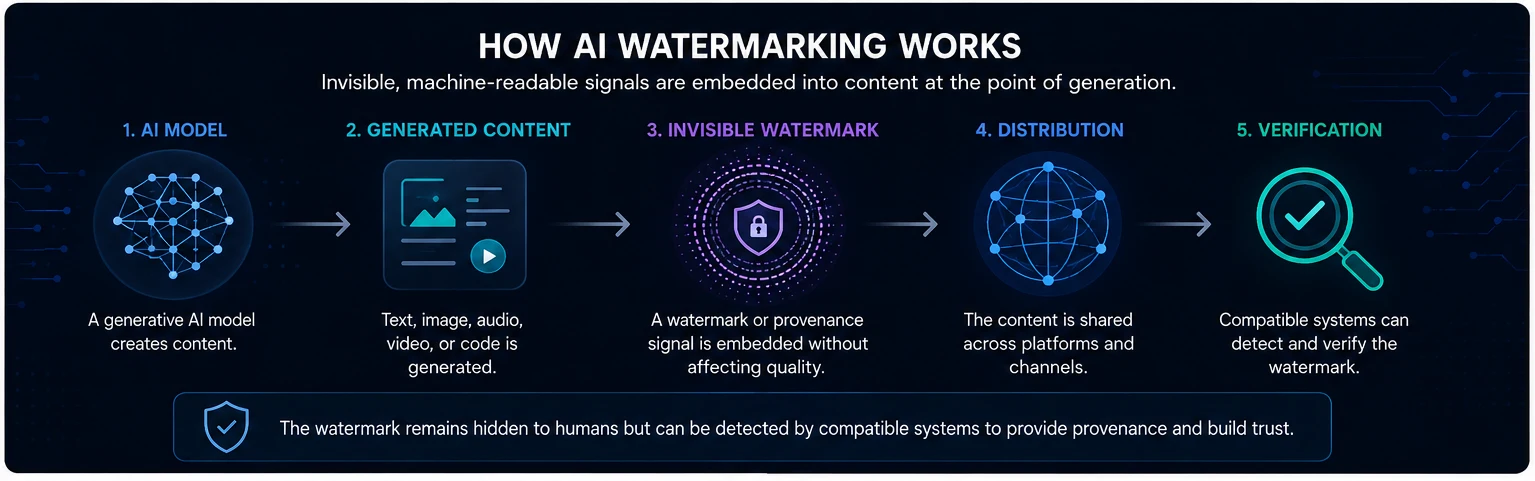
The basic idea behind AI watermarking is simple: instead of relying only on an external AI detector that tries to guess whether something was generated by a model, the model can embed a signal into its own output while the content is being created.
That signal may be embedded directly into pixels, audio, video frames, or the statistical pattern of generated text. AI watermarking and metadata-based systems such as C2PA take related but different approaches — one embeds a signal in the content itself, the other attaches cryptographically signed provenance information to a file.
Neither approach is a perfect universal detector. A missing watermark does not necessarily prove that content is human-created, and a detected watermark does not automatically establish exactly how much of a piece was written by AI or how much human work was involved.
How Google, OpenAI, and Anthropic Are Approaching Watermarking
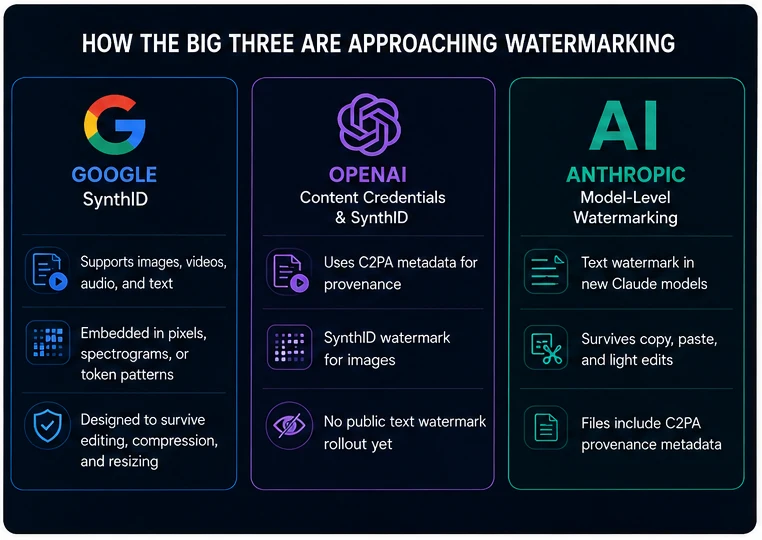
The three companies are taking noticeably different approaches to AI watermarking and content provenance. Here’s the comparison at a glance before the full breakdown of each.
| Provider | Text | Images / Video | Audio | Public Detection Tool | Rollout Started |
|---|---|---|---|---|---|
| Google (SynthID) | Yes — token-pattern watermark | Yes — pixel/frame-level watermark | Yes — audio watermark | Yes — Gemini + SynthID Detector | 2023 (images); expanded since |
| OpenAI | Built, not publicly deployed | Yes — C2PA metadata + SynthID | Supported — SynthID + C2PA | Yes — OpenAI verification tool — openai.com/research/verify | May 19, 2026 (images) |
| Anthropic (Claude) | Yes — embedded watermark | Files — signed C2PA metadata | Not applicable | No — detection tooling still in development | Aug 2, 2026 (new models) |
Google: SynthID Across Text, Images, Audio, and Video
Google DeepMind’s SynthID is one of the most established multimodal watermarking systems. Google launched SynthID for AI-generated images in 2023 and subsequently expanded the technology to text, audio, and video.
- Images: SynthID embeds an invisible signal directly into generated image pixels. Google designed the watermark to remain detectable through common transformations such as cropping, filtering, and lossy compression.
- Video: The watermark is incorporated into generated video content, building on the underlying image watermarking approach.
- Audio: SynthID embeds an inaudible signal into supported AI-generated audio. Google says the watermark is designed to survive common changes such as noise, MP3 compression, and speed adjustments.
- Text: SynthID modifies token-selection probabilities during generation. The resulting statistical pattern is intended to remain imperceptible to readers while providing a signal that can be identified by compatible detection systems.
Google is also explicit about the limitations. SynthID is not presented as a universal solution for identifying every piece of AI-generated content. It is a provenance signal that can contribute to more reliable identification systems.
OpenAI: C2PA Metadata Plus SynthID for Images and Audio
OpenAI is taking a layered provenance approach rather than relying on a single watermarking technique.
- C2PA: OpenAI uses the C2PA standard to attach provenance information to supported generated content in a standardised, machine-readable format.
- Images: Images generated through supported OpenAI products can include C2PA Content Credentials and a SynthID watermark.
- Audio: OpenAI has used audio watermarking in some systems, but its current public provenance documentation is primarily focused on C2PA and SynthID for generated images.
- Why layer both? C2PA can provide richer information about where and how content was created, while SynthID provides an additional signal that may survive transformations where metadata does not.
- Text: OpenAI has researched text watermarking and detection, but there is currently no publicly documented OpenAI text-watermarking rollout comparable to Google’s SynthID text implementation or Anthropic’s newer Claude marking system.
OpenAI’s provenance approach is therefore more clearly documented today for generated images and audio than for generated text. This makes OpenAI’s strategy meaningfully different from Anthropic’s current focus on text marking.
OpenAI: Advancing Content Provenance
OpenAI Help: Provenance Signals, Content Credentials & SynthID
Anthropic: Model-Level Marking for New Claude Models
Anthropic has taken the most notable step in the current text-watermarking discussion. According to Anthropic’s documentation, supported Claude models launched on or after August 2, 2026 can embed an imperceptible watermark directly into generated text.
- Text: Claude embeds an imperceptible statistical watermark into generated text. The signal is based on the statistical pattern of model-generated content rather than visible characters or a separate file.
- Copy and transfer: The mark is designed to remain present through ordinary copying and plain-text transfer.
- Editing: The signal is not guaranteed to remain detectable after substantial rewriting or transformation. It should therefore be treated as a provenance signal rather than an infallible forensic test.
- Files: Supported generated files can carry signed provenance metadata using C2PA-based Content Credentials.
- Coverage: Anthropic’s documentation describes the marking system across supported Claude experiences and access methods.
The important distinction is that Anthropic’s text marking is implemented as part of the generation process. It is therefore fundamentally different from a third-party detector that analyses writing after publication.
Anthropic: How Claude Marks AI-Generated Content
How to Check for AI Watermarks: Official Tools by Provider
Each company only checks for its own watermark, not for AI content in general. There is no single tool that verifies content from Google, OpenAI, and Anthropic at once. Here’s what’s actually available today, and how to use it.
Google: SynthID Detector
Google offers two ways to check for a SynthID watermark for supported images, video, and audio:
- Open the Gemini app and upload the image, video, or audio file you want to check.
- Ask Gemini directly whether the file contains a SynthID watermark.
- Gemini scans the file and reports whether a SynthID signal was found.
Google has also launched a dedicated SynthID Detector verification portal aimed at journalists, researchers, and media organisations, which supports image, video, and audio uploads. Text detection has been rolling out separately and access has historically been more limited than for other formats.
Keep in mind: SynthID only confirms whether Google’s own watermark is present. It cannot tell you anything about content generated by other AI tools, and a “not detected” result doesn’t mean the content is human-made — it may simply have come from a different source.
Tool: Google DeepMind: SynthID
OpenAI: Public Verification Tool
OpenAI runs a public verification tool that checks for both C2PA Content Credentials and SynthID watermarks:
- Go to OpenAI’s public verification tool.
- Upload the image you want to check.
- The tool reports whether it detects Content Credentials, a SynthID watermark, or both, and confirms whether the file came from ChatGPT, the OpenAI API, or Codex.
As of the July 31, 2026 update, OpenAI’s provenance tool also supports verification of supported audio files generated through ChatGPT Voice and the OpenAI API, using SynthID watermarking and C2PA signals. OpenAI is explicit that a failed detection is not a definitive indication that content is human-made — provenance signals can be stripped or degraded through media-specific transformations such as screenshots, re-encoding, or heavy editing. There is currently no equivalent public tool for checking OpenAI-generated text.
Tool: OpenAI: Verify
Anthropic: No Public Detection Tool Yet
This is the one gap worth flagging clearly: Anthropic has not released a public tool for checking whether text was marked by Claude. Anthropic’s own documentation states that it is still working on detection mechanisms and will share technical details once they’re available — there’s no published timeline yet.
In practice, this means that today, there’s no official way for a reader, editor, or SEO team to check whether a piece of text carries a Claude watermark. That’s expected to change as Anthropic publishes its detection documentation, but for now, the watermark exists without a corresponding public checker.
Anthropic: How Claude Marks AI-Generated Content
One more caution: a number of third-party sites market themselves as universal “AI watermark detectors” or “SynthID checkers.” Most of these don’t actually verify a provider’s cryptographic watermark — that requires private keys only the provider holds — and instead run their own separate, probabilistic AI-detection models. A few even double as watermark-removal services. Treat results from unofficial tools as rough guesses, not verification, and rely on each provider’s own official tool for anything that matters.
AI Watermarking vs. AI Detection: They Are Not the Same Thing
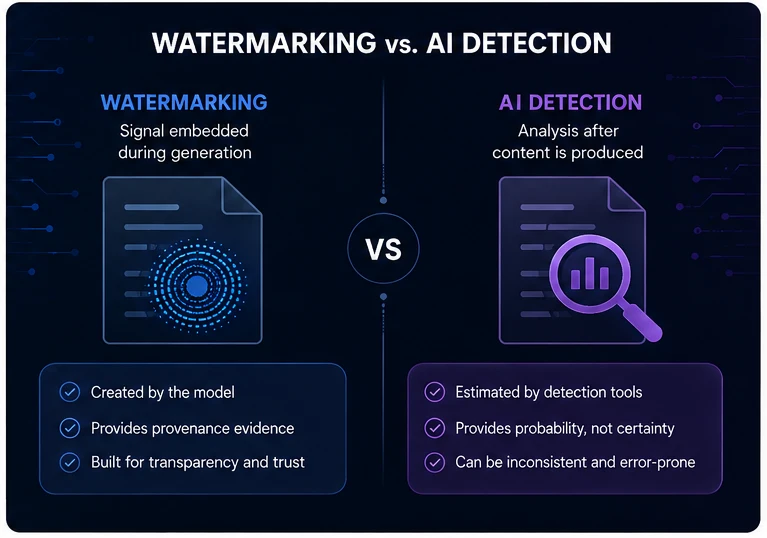
This distinction is critical.
A traditional AI detector looks at a piece of text or media and attempts to estimate whether AI was involved. The detector may use statistical patterns, classifiers, or other signals without having access to the original generation system.
A watermarking system works differently. The originating AI system intentionally embeds a signal during generation. A compatible verification system can then look for that signal later.
That means a detected watermark can be stronger evidence of interaction with a particular AI system than a generic detector’s probability score. But it still does not automatically tell you:
- how much human editing occurred;
- whether the entire document was generated by AI;
- who prompted the system;
- why the content was generated; or
- whether the final publication is accurate or high quality.
In other words, provenance is not the same thing as authorship, quality, or accuracy.
Does AI Watermarking Affect Google SEO?
For website owners and SEO teams, this is probably the most important practical question.
AI watermarking itself should not be treated as equivalent to a Google Search penalty. Watermarking and provenance systems are primarily designed to indicate or verify the origin of AI-generated content. They do not automatically establish that a page is low quality, misleading, or unsuitable for search.
The more relevant SEO question remains how the content performs against broader search quality expectations. Content that is useful, accurate, original, well-produced, and genuinely satisfies the searcher’s intent is a different question from whether the content carries a provenance signal.
That distinction matters because an organisation can use AI during research, drafting, translation, editing, coding, or content production while still applying substantial human review and expertise.
For SEO teams, the practical response is not to panic about watermarking. Instead, maintain clear editorial workflows, fact-check AI-assisted material, add genuine expertise and original value, and keep records of the human review process where compliance or client requirements make that necessary.
What Happens When AI-Generated Content Is Edited?
AI watermarking is not necessarily permanent in every form.
For images and other files, metadata-based provenance can be lost when a file is converted, resaved, uploaded through a system that strips metadata, or captured as a screenshot. Pixel-level watermarks can be more resilient, but they are not guaranteed to survive every transformation.
Text watermarking presents a different challenge. Because the signal is statistical rather than visible, normal copy-and-paste does not necessarily remove it. However, substantial rewriting, translation, paraphrasing, or other transformations can weaken the statistical pattern and reduce detection reliability.
This is why a watermark should be treated as evidence of a provenance signal, rather than as an infallible forensic proof of who wrote every sentence.
What This Means for Content Creators and Developers
If you use ChatGPT, Claude, Gemini, or other generative AI tools in professional workflows, several practical conclusions follow.
- AI watermarking is making AI-generated content easier to trace back to its source. The industry is moving toward provenance systems that work at the point of generation rather than relying entirely on external detectors.
- Watermarking is not a quality score. A provenance signal does not tell you whether content is useful, accurate, original, or commercially valuable.
- Editing can affect detection. Moving content between formats, substantially rewriting text, or modifying media can weaken some provenance signals.
- Different providers use different systems, and different checking tools. Google, OpenAI, and Anthropic should not be treated as having one universal watermarking standard, or one universal place to verify content.
- Human review still matters. For professional publishing, the important operational controls remain fact-checking, editorial review, disclosure where required, and a transparent content-production process.
Frequently Asked Questions
Does AI watermarking mean every AI-generated article will be automatically detected?
No. Watermarking systems are provider-specific, and detection depends on whether compatible provenance signals are present and detectable. A watermark that is not detected does not prove that content was written entirely by humans.
Does Claude watermark every piece of text?
Anthropic says supported Claude models launched on or after August 2, 2026 can embed imperceptible marks into generated text. Coverage of older models is subject to Anthropic’s rollout plans.
Can an AI watermark be removed?
It depends on the technology. Metadata can be lost through file transformations, while statistical text watermarks can become weaker after substantial rewriting or paraphrasing. Neither type should be considered completely indestructible.
Does an AI watermark prove that an entire article was written by AI?
No. A detected provenance signal can indicate that content was generated or processed by a particular AI system, but it does not by itself establish the extent of human involvement or provide a complete authorship history.
Does AI watermarking hurt SEO?
There is an important distinction between provenance and search quality. A watermark is a signal about content origin; it is not, by itself, a measure of whether content is useful or high quality. SEO teams should focus on originality, accuracy, search intent, expertise, editorial review, and the overall value provided to users.
Does the EU AI Act require Google, OpenAI, and Anthropic to use the same watermark?
No. Article 50 establishes transparency obligations, including machine-readable marking requirements for relevant AI-generated or manipulated content, but it does not mandate one universal technical watermarking implementation.
Does Article 50 apply outside the European Union?
The legal obligations are connected to the EU AI Act and its scope. Individual providers may nevertheless choose to apply their marking systems more broadly than the minimum legal scope. That is why a company’s product policy can be global even when the regulation itself is EU-specific.
Will content published before August 2, 2026 need to be relabelled?
The European Commission says AI-generated or manipulated outputs that were generated and already made available before August 2, 2026 do not need to be labelled retroactively under Article 50.
Is there a public tool to check if text came from Claude?
Not yet. Anthropic has not released a public checker for Claude’s text watermark. Its detection tooling is still under development.
The Bottom Line
AI content watermarking is moving from an experimental research topic toward a practical part of the AI ecosystem.
Google has spent years building SynthID across multiple content formats and provides public verification options for supported content. OpenAI is combining C2PA provenance metadata with SynthID for generated images and audio, backed by its own verification tool. Anthropic has made model-level marking of newly generated Claude content one of the most visible examples of text watermarking at scale — but hasn’t yet given the public a way to check for it.
The important takeaway is not that AI content will suddenly become universally detectable. It is that AI watermarking is becoming a built-in property of content generation, even where the tools to verify it are still catching up.
For publishers, marketers, SEO professionals, and developers, the sensible response is to understand the technology rather than assume that a watermark is either a perfect detector or a ranking signal. The industry is moving toward a future where the question is increasingly not just “Was AI used?”, but “Where did this content come from, how was it created, and what can be verified about its provenance?”
Last updated: August 14, 2026. AI watermarking technologies, regulatory guidance, provider coverage, and verification tools are evolving rapidly. For compliance decisions, consult the latest documentation from the relevant provider and the European Commission.